Abstract
Emotional Design, designed by cognitive scientist Don Norman, shows how the principles of human psychology apply to the invention and design of new technologies and products. Norman’s work helps manufacturers and designers to create products that activate the appropriate emotions in order to create a positive user experience. Emotional design is divided into three levels that refer to brain functioning. The Visceral level, which is agile, and therefore makes quick judgments of what is good or bad, pleasant or not, dangerous or safe. Behavioral is where the majority of human functioning takes place. It can be influenced by the visceral layer, and it can also influence the reflective layer. The Reflective layer, as the name suggests, reflects and observes the behavioral level and can also influence it. This work aims to discuss the concepts that surround emotional design, especially with regard to Don Norman’s work, and to evaluate the main social networks in the market taking into account the knowledge based on studies in this field of design. And so, understanding how emotional design can be applied to software solutions. For this, the main features of some of the most famous social networks on the market were elicited: Facebook, Youtube, WhatsApp, Instagram and Twitter. They were subjected to an assessment taking into account the degree of occurrence (low, medium or high) of the levels (visceral, behavioral or reflective) of emotional design. In this way, it was possible to understand in a more profound and systematic way how these companies work on the design of their applications and, which later resulted in the success of these brands. The study showed that the level most present in social networks was behavioral. This leads us to understand that people use social networks to do many of the activities that they already did, but that the social network ended up facilitating or making them more interesting through the virtual environment. The reflective level also showed a significant presence, which suggests that users have a great connection with the content they post and consume. Finally, the visceral level had the lowest rate of presence in the functionalities, showing that people do not use social networks for their first impression or aesthetics of the page, but for deeper reasons.
Introduction
Humanity has long lived surrounded by objects that make their owners feel something. Some are fun, others necessary; some frustrate, make daily life easier or make it harder. This relationship between design and emotion has therefore always been part of our lives. Either way, this union was named “Emotional Design” by Don Norman.
Knowing what users expect from an application is a challenge researchers have been trying to unravel in order to improve their techniques for planning product development. In software design, especially when it comes to aesthetics and the user’s interaction with the system, causing a positive impact such as excitement and enthusiasm is a factor that can determine a product’s success (Desmet, 2005). Experiences with a positive impact are fun: they make you smile, break out of the ordinary and bring satisfaction to body and mind (Shneiderman, 2004). These feelings of satisfaction are similar to the ones we get from solving a problem, playing an instrument, learning something new or going to the movies. In the social sphere, there are also parties and gatherings with family or friends. Ben Shneiderman, however, draws attention to the possibility of finding satisfaction in the absence of activity. That is the case when a person reaches a state of calm and tranquility, through meditation or just by taking a moment to relax. When this happens, the person’s focus and attention are not on completing a goal, but on letting go of goals (Shneiderman, 2004). This is therefore an important issue for software designers to consider.
In this sense, Lockner and Bonnardel state that concern for the design of software graphical interfaces has been growing over the years. And, according to Norman and Nielsen, this concern can go further: it covers the whole user experience in a broader way, from the moment users leave the store with the product — be it a computer or a smartphone — to when they take it out of the box and have their first contact with the device.
Although software developers usually focus on usability and ergonomics problems, which creates a tendency to focus on the user’s cognitive and motor perception (Damien, 2015), the user’s emotional side cannot be left aside. Lockner and Bonnardel state that users’ feelings are an extremely relevant topic for cognitive science and design. Norman, in turn, notes that new systems should also offer people a bit of fun and pleasure. Thus, beyond their usability characteristics, interactive systems should be seen as channels for feelings through interface design. More aesthetic and pleasant software is perceived as more reliable, performant and satisfying, while less aesthetic and less pleasant software causes more frustration, irritation and anxiety, from the user’s point of view (Pengnatea, 2017) (Hancock, 2005).
In this work, I first gathered the requirements of the main social networks on the market in order to list the features most relevant to users, such as chat, stories, activity feed and so on. Then, I evaluated the design of these features through the lens of Don Norman’s emotional design, which is therefore the main bibliographic basis of this research.
The visceral level is the most primitive one and the first to be activated after the user’s sensory perception, that is, as soon as they feel, see, smell or hear the product. The visceral level is therefore strongly associated with first impressions; symbolically, it is the user’s “love at first sight” for the product. The behavioral level reflects how immersed the user is while using the product. It is strongly associated with the software’s usability and with how interactions with it happen. Emotionally, when use is fluid and natural, the product brings the person a feeling of satisfaction. Finally, the reflective level is how the application makes users feel. This level is decisive for users to conclude whether or not they want to go through that experience again.
The goal, therefore, is to present these features and analyze how they can impact the user experience. This work seeks to uncover resources these companies use that can serve as inspiration for other software projects, or simply help understand how they work and explain the success of these brands.
This work is organized as follows: the Emotional Design section details the levels of emotional design, how they work and how they appear in products; it also explains Norman’s work, so that it is clear how this research was conducted. Next, the Methodology section clarifies the concept of social networks and discusses why the applications chosen for this research were selected. The Results and Discussion section discusses how the design levels appear in social networks and which levels are most representative in each feature. In the Final Considerations, a quantitative survey was made of how often each level of emotional design occurs in each feature, to understand which level appeared most in social networks and how this impacts the user’s relationship with the application. Finally, the Conclusion presents the results and discussion of the evaluated interfaces, the difficulties faced in this work and proposals for future work.
Emotional Design
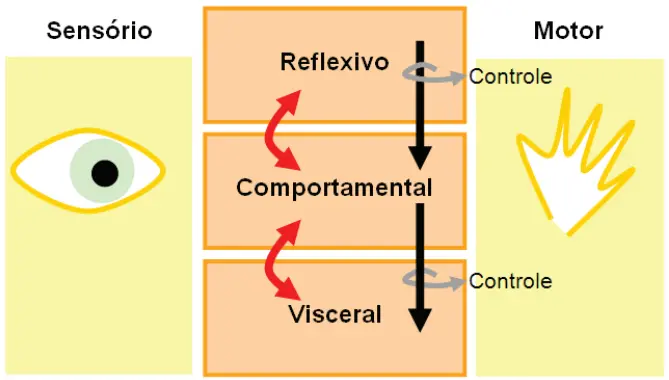
In the book Emotional Design, Norman proposed a framework, shown in Figure 1, to analyze products holistically, including their attractiveness, their behavior and the impression they make on the user. In his work, different aspects of products were associated with different levels of processing by their users: visceral, behavioral and reflective. These three levels translate into three different kinds of design. Visceral design is mainly about the initial impact and appearance. Behavioral design is about appearance and behavior — the whole experience of using a product. And finally, reflective design is about the thoughts after using the product, that is, the memories it brings back, the image that portrays it, the message the product sends to others about its owner’s taste.
To illustrate the concepts defined by Don Norman, consider the phone dock shown in Figure 2, designed by an artist known online as Woodguy. The artist is bringing retro back to smartphones with the look of the old telephone your grandparents probably used. This kind of memory is what Don Norman calls reflective design, since memory and attachment are the reasons the owner likes the piece. The product is simple and elegant, characteristics that point to visceral design: anyone full of nostalgia would probably want one at home. The base holds a dock for the smartphone and another for the handset. The dock is wireless; it uses bluetooth technology, which means you can talk on the handset up to 10 meters away. This fits behavioral design, which covers how the product works and what it is like to use it.

Each of the three levels conceived in Norman’s work, together with professors Andrew Ortony and William Revelle of the Department of Psychology at Northwestern University (United States), is discussed in the following sections.
Visceral Level
The visceral level, pre-wired or automatic, is responsible for the quickest judgments, for example: what is good or bad, safe or dangerous (Norman, 2004). According to Tonetto and Costa, this level can be considered the most primitive perception of the human brain.
These perceptions are part of us, although it is often hard to explain why we have these feelings. Hence the name of the level, “visceral”, from the viscera, the inside, the innermost. They are perceptions most people have from birth and are therefore deeply rooted in the individual: they are genetically pre-wired.
On the positive side, examples include comfortably warm places, scents, sweet tastes, well-lit environments, bright colors, soothing sounds, sounds of nature, simple melodies, affectionate attitudes, symmetry, smooth materials, soft textures, patterns, order and sensual feelings. Alongside these positive perceptions there are also negative ones, which are likewise perceived spontaneously and unconsciously: loud noises, poorly lit or unexpectedly bright environments, extreme heat or cold, empty terrain with no clear boundaries, dense and crowded terrain, heights, crowds, the smell of spoiled food, feces, body fluids, vomit, bitter tastes, venomous animals (spiders, scorpions and snakes), irregular shapes, chaos and rough textures (Norman, 2004).
It is clear, then, that visceral design is people’s most primitive and natural level of perception. It is as if people were born with that concept built in, in most cases even regardless of culture. Norman argues that studying visceral design is actually very simple: just put the product in front of the user and wait for their reactions of satisfaction or rejection. This activity (evaluating the visceral level) is about understanding the person’s immediate response to the product (Norman, 2004; Tonetto, 2011).
Behavioral Level
The behavioral layer is the one that covers most human behavior. It has access to both sensory and motor information, which help determine how the user behaves with the product. This level can be influenced by the reflective level and, in turn, can influence the visceral level (in descending order, if you look at Figure 3). The behavioral level is extremely important for humans in activities that require learning, such as everyday activities. It is also this ability that determines people’s specialties, when they reach the peak and mastery of a certain activity. That is why the behavioral level is not located in the conscious mind. Think about it: a guitarist who has mastered the instrument does not need to think through every note they are about to play. They do it without consciously thinking “now I’m going to play a C”; in fact, many musicians can play their instruments while holding a conversation with someone else. Another, even more common, example is drivers. People who have a driver’s license, after some time behind the wheel, stop thinking about shifting gears, braking, accelerating and using the turn signals.

In the world of technology, pinch zoom, illustrated in Figure 3, is an example of the behavioral level at work. This feature first appeared on laptop touchpads and later on touchscreen phones. It is an interaction between user and device characterized by a pinching movement of the fingers, used to zoom into parts of images and texts. It is a behavior humans learned from living with technology, and for new generations it is very natural. In fact, if an app shows a photo and does not let the user zoom with this gesture, chances are the user will feel frustrated, because it would break a concept that is now natural and obvious to people; it would be like trying to use scissors that don’t cut. This field is actually well explored by the design community for technology solutions. Usability is an HCI field that is widely studied and deals with ease of use, an extremely important factor in the behavioral level (Nielsen, 1994). According to Norman, good behavioral design values the product’s usefulness, how easy it is to understand and use, its usability and the physical way the user perceives it.
Building functional products may seem obvious, but the user’s needs are not always explicit. In a TEDx (Technology, Entertainment and Design) talk, professor Pieter Desmet describes an experiment in his class, in which each student had to bring an object and explain why that object was important to them from a design perspective. One student brought a seemingly ordinary pencil and, when asked why, answered that the pencil was not cylindrical, which kept it from rolling off the table, something that really annoyed him about other pencils (Desmet, 2011). This is an extremely subtle detail that many people had never considered. How many years have people used ordinary pencils without noticing this problem? This kind of innovation most likely does not come from the user’s initiative or from a questionnaire designers hand out to a group of people. It comes from observing the activities that are part of people’s routines. This is an extremely important step in designing a successful product. Many projects fail because designers think in a self-centered way and believe they have the answers to the user’s problems. However, according to Norman, behavioral design must be human-centered (Norman, 2004).
Reflective Level
The last level concerns the most lasting aspects of the user experience. It is about the memories the product brings to the user, the story it tells and the meanings it carries. It is a very complex kind of design, because it involves culture, messages and memory (Norman, 2004). Think of when you decide to buy something more expensive, such as one phone brand instead of another because you consider it better than the rest, or a handmade decorative object. The reasons for that choice are cultural: the product’s history, the status it conveys or any other feeling. There are no functional or practical criteria that justify it. If there were, blind tests would not reveal so many contradictions, with blindfolded people unable to tell even which brand is their favorite soda (Tonetto, 2011). Research in psychology shows that it is this emotional side, combined with the cognitive one, that makes life feasible amid a vast number of options and pieces of information (Kahneman, 2003). The reflective level strongly influences people through brand names, through a product’s prestige and status, and through the value the product adds to their self-image — hence the sales of expensive whiskeys, watches, luxury cars and homeware (Norman, 2004).
At this point, a kind of dispute may arise, since it becomes hard to say why the user likes the product or not, as two levels may be at play at the same time. In this example, does the user like the piece because they find it beautiful (visceral) or because they like what it means (reflective)? There is no way to know for sure, so the levels compete. That is where things start to get a little more interesting. As a comparison, imagine a person admiring a work of art in a museum. Are they enjoying it for its visual and aesthetic qualities (visceral level)? Or does the pleasure come from what the work means to them, from the moment of reflection, from their erudition, that is, their understanding and technical knowledge that let them grasp what the work proposes (reflective level)? These questions show that more than one level of design can perfectly well occur at the same time.
It is in this context that Norman said, about Figure 4:

“I bought an expensive juicer, but I can’t use it to make juice! Zero for behavioral design. So what? I proudly display it in the entryway of my home. A hundred for visceral appeal. A hundred for reflective appeal.”
— Don Norman
Methodology
Social networks are software products born in the age of the internet, and today they rank high on the lists of most visited websites and play an important role in people’s lives (Jonathan, 2015).
They offer people a wide range of entertainment through shared content, whether humorous or cultural, such as music and videos. Some people also use them as a news source, or to talk to distant friends and family. Whatever role they play in the user’s life, social networks are references for designers and engineers who want to build new digital products. In fact, Facebook and Google are examples of companies that have contributed directly to software engineering through frameworks and development tools, such as the React library maintained by Facebook or Material Design maintained by Google, which are used by many companies in their products.
In this sense, this work explored the design elements present in social networks in light of Norman’s emotional design principles. That is, identifying how the levels of emotional design occur in social network software.
As for its purpose, this is basic research, since it seeks to produce knowledge with no immediate application, in order to understand and clarify how emotional design appears in software products. As for its objectives, it is exploratory and bibliographic, since it provides more information on emotional design. As for the nature of the data, it is qualitative. As for data collection, it is bibliographic research, since the work draws on another author’s works as its foundation.
To select the social networks to evaluate, I used Statista (Figure 5), a German online statistics platform that gathers data from official market and opinion research institutes. It is one of the most successful statistical databases in the world (Statista, 2019).
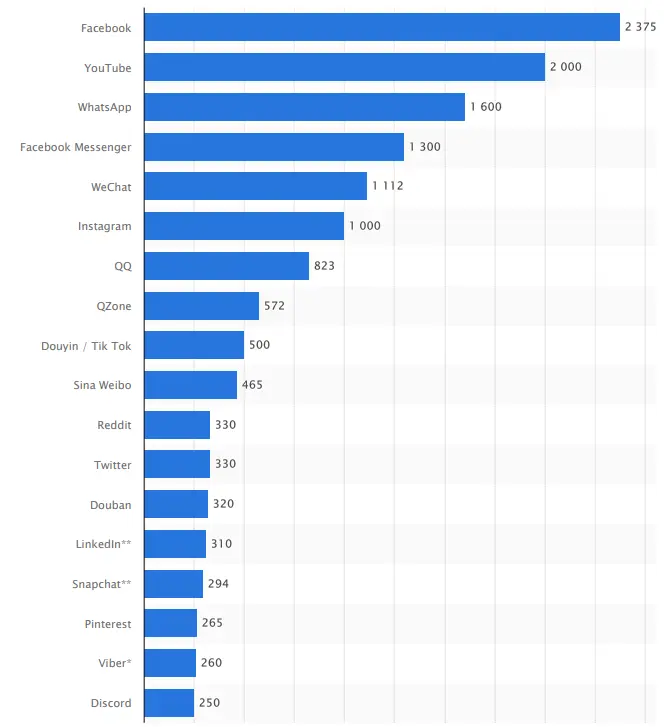
From this list, I chose to evaluate the most relevant applications, considering their popularity and similar focus. The following social networks were therefore considered:
- YouTube
Besides this ranking, these tools were selected because they are already considered successful products on the market.
The social networks considered in this research are mainly about social interaction and entertainment. Some other social networks are used for more specific purposes, such as work, portfolios or corporate chats. Including them could create inconsistencies in the analysis, since, with different focuses, the same design elements may have been conceived with different goals.
After surveying and choosing the social networks for this research, I had to analyze their resources, that is, the features each application offers. This step matters because it is necessary to know what kind of activity keeps users connected to the social network. Knowing where (social network) and what (application feature) users do, it is possible to infer what makes these companies successful and justify it through a more technical reading based on emotional design.
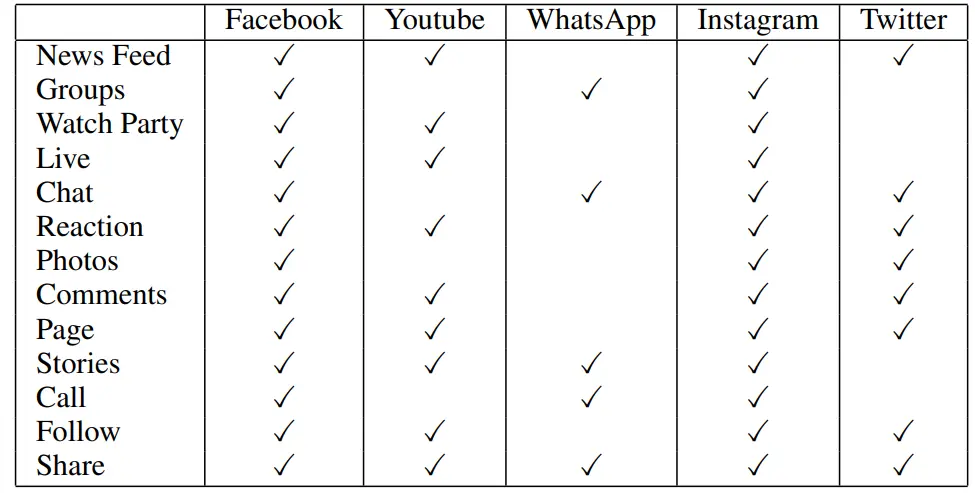
The next section details the features in Table 1 and analyzes them in terms of the emotional design aspects proposed by Norman.
Results and Discussion
In this section, I present the results of analyzing the features listed in Table 1 in terms of emotional design.
News Feed
The news feed is the feature that shows what is new on the network. It is made up of posts by the application’s users. For example: a new photo, text, news story, video or any other content added to the social network by a user or a page is shown through the news feed. In itself, it has no strong emotional characteristic, since it is only the channel through which content spreads. The emotional factor is therefore tied more to the content that circulates in it than to the feed itself. Even so, it can be associated with the behavioral level, since it is part of the system’s behavior and without it the social network would be directly affected; and also with the reflective level, since in some cases it can reflect the user’s status: a photo of a dinner, of something the user bought and wants to show off, trips and so on. Keep in mind that these cases depend directly on the content involved and not only on the feature.
Groups
Groups on social networks promote greater interaction between users, since they deal with topics shared by a specific group. For example: groups about sports, music, a favorite artist and so on. They also lack a very representative emotional level. Similarly to the news feed, in some cases they can trigger the user’s reflective level, as they are linked to a sense of exclusivity — but, again, this depends directly on the type of group. In the specific case of WhatsApp, this feature has behavioral importance in the system, since many users choose it precisely because it offers this kind of behavior.
Watch Party
Watch party and live are very similar features. Both are real-time video broadcasts; the subtle difference is that a live is a video recorded from the broadcaster’s device, that is, the broadcasting user creates the content. A watch party, on the other hand, is a space where people watch the same video at the same time, which can be a concert, a movie, a play, a class and so on. The idea is just like a movie theater showing a film, with each person arriving at that screening. In this feature, the level of interaction is very high through comments and reactions (like, love, haha, wow, sad, angry). This indicates a strong presence of the visceral level, since it triggers primitive feelings such as happiness, fun and well-being that come from this interaction and are not thought through by the user; they are simply perceived automatically as a result of using the feature. However, they are triggered by the “reactions” feature (see Reactions) present in Watch Party, not by Watch Party itself.
Live
Live, unlike watch party, lets users broadcast something they are recording to other users at the same time. It allows a user to share a dinner with distant family or hold a meeting. A market that has grown a lot through this technology is the broadcasting of video game matches. Today, many people play professionally and broadcast their matches to an audience; they are called streamers. Although this feature takes a different approach from watch party, the feelings it draws from users are the same: social interaction, fun, cooperation and reconnecting with loved ones are some examples.
Chat
Chat is one of the most widespread tools on the internet and has been with it since the beginning. The feeling chat draws from the user depends directly on the content of the conversations. But it is important to point out that chat introduced a new form of communication, as letters, radio, telephones and fax once did. Many people therefore prefer this form of communication for its convenience and speed. Communicating can be more pleasant (or not) through chat: virtual, instant and accessible, since messages can be sent from anywhere with an internet connection, as text or as calls, and conversations are saved. The closest thing to it was SMS, which in many cases costs more than internet chat.
Reactions
Reactions on social networks let users express their feelings about content, which indicates the presence of the visceral and behavioral levels. With television, for example, the viewer’s position is almost entirely passive, as they only watch the content, whereas on a social network they take a more active role, since they can give their opinion on it. Some people may therefore prefer to consume content on the internet because they can interact with it; the product’s behavior is different. TV networks also try to bring this kind of feature into their programming by reading internet comments on air, taking phone calls or SMS, because it is something that attracts people. Even so, the visceral level is also very present, since it deals with the user’s most intrinsic feelings. The feeling users express on social networks is usually not premeditated. They simply find something funny, sad or interesting. It is the brain’s quick response to that content.
Photos
Being able to share photos attracts many users. On Instagram, for example, it is the system’s main feature and what keeps it successful in the market. People’s need to show their activities and receive attention and approval explains why users embrace this feature. This indicates an extremely strong presence of the reflective level, the one associated with a person’s status. Beyond that, photos are tied to users’ memories and to the stories those moments mean to them. This feature has no practical utility for users, such as image processing, for example, and yet they use it all the time. The behavioral level is not what best explains the use of this feature, although it is present, since the way people consume photographs changed with the arrival of technology. Today, many people replace printed photo albums with virtual ones because they are easier to use and can hold a large number of photos. The visceral level is also strong in this feature. People don’t always post or “like” someone’s photo because they have an emotional connection with it. Often the user simply found the image beautiful because of its colors, lighting, composition and so on. Photos can attract or repel users depending on their content, and images with a strong emotional impact can be designed for that purpose. In other words, advertising images, for example, are designed to attract consumers in the very first moments and end up appealing to the user’s visceral level; just as cigarette packs show images that cause disgust, since the intention is to campaign against smoking. Norman gives an example in his book: this feeling of disgust is triggered when someone comes across a spider or a snake; regardless of the person’s culture, the most common reaction is to feel fear and want to stay away from the animal. Sweets, on the other hand, cause attraction and positive feelings. This principle, which belongs to the visceral level, can be used in advertising or in users’ everyday photos.
Comments
Comments on social networks are extremely important elements for users. Moving the consumer into a more active position completely changed the way users consume content. Now users not only read and/or watch information, they also express their opinion. This feature is tied to the behavioral level, since it directly affects how users deal with content. It can also be linked to the reflective level: just like photos, social interaction responds to the user’s status and stories, but now through their opinions.
Pages
This feature is used to organize content on the social network. A page has a subject, which can be political, sports, advertising and so on, and by “following” the page the user starts receiving that specific content. It is not private in any way, since any user can follow or unfollow the page at any time, so it represents the user’s preference for the subject, and those who are not interested don’t have to come across it all the time. This feature has a high behavioral level, since it gives users control over the content they want to consume — unlike radio or TV, where control over content belongs almost exclusively to the broadcaster and the most the user can do is change the channel or station. It therefore has a direct impact on how users consume information, and may also be related to users preferring this medium over more traditional ones. The reflective level can also be mentioned here. An example of the reflective level at work in the human mind is when a person likes a more elaborate kind of music, usually associated with classical music, because it carries an intellectual atmosphere and even status (Norman, 2004). So, if a person’s motivation for following a page is this search for status, we can say it is the reflective level at work.
Stories
Stories can be classified in a very similar way to the photos feature, since, in essence, it is a photo-sharing feature. However, it has a very distinctive new element: time. Stories are short, since users can view each piece of content for at most 15 seconds, and the content is only available for 24 hours before being deleted. This time limit increases people’s focus in many cases. In emergencies, for example, when people must act fast, focus and attention tend to increase. Imagine yourself in a car accident: all your energy will be concentrated on a single goal, getting out of the car. The contexts are obviously very different, but stories have the potential to hold users’ attention through this sense of urgency — “If I don’t see this photo now, I might not be able to see it later.” Since this is tied to people’s most automatic and pre-wired level, it indicates the presence of the visceral level. The behavioral level is also very present, since stories change the way people consume photos and videos, demanding attention in the moment and not allowing the image or video to be contemplated for long. That habit of sitting down to look at photos with the family is not how stories work; the idea is instant consumption of content. Also, the reasons that justify the reflective level in the photos feature are exactly the same for stories: the value placed on the user’s stories, memories and status.
Calls
Users are extremely used to the calls feature. Nothing really new here, and it works in a similar, if not identical, way on every social network. The level most noticeable here is the behavioral one, since its impact on the system’s behavior is clear. Many people use this feature precisely because it is easy and even because of the financial advantages compared to conventional calls. In other words, internet calls can be a better deal than calls over a phone line. So the way (behavior) social networks perform the same task can be more efficient for some users.
Follow
The option to follow a page or another user on the social network makes their content show up more often for the follower. That is, if you follow a page, its content will be shown to you more frequently. If you don’t, it will appear less often or not at all. This gives end users control over what they want to consume or not, a characteristic of the behavioral level that offers users a freedom that traditional media don’t.
Share
Sharing content is something present in every social network and is strongly associated with the system’s behavioral level, which gives users a more active role and consequently affects how they deal with information, since today they are not just spectators. The reflective level can also appear here, but it depends on the content being shared. Many people share poems, songs and photos that may be associated with the memories and meanings the content has for them.
Final Considerations
To make the presence of the levels of emotional design easier to see, each feature was given a degree of occurrence. The possible values are Low, Medium and High, as shown in Table 2:
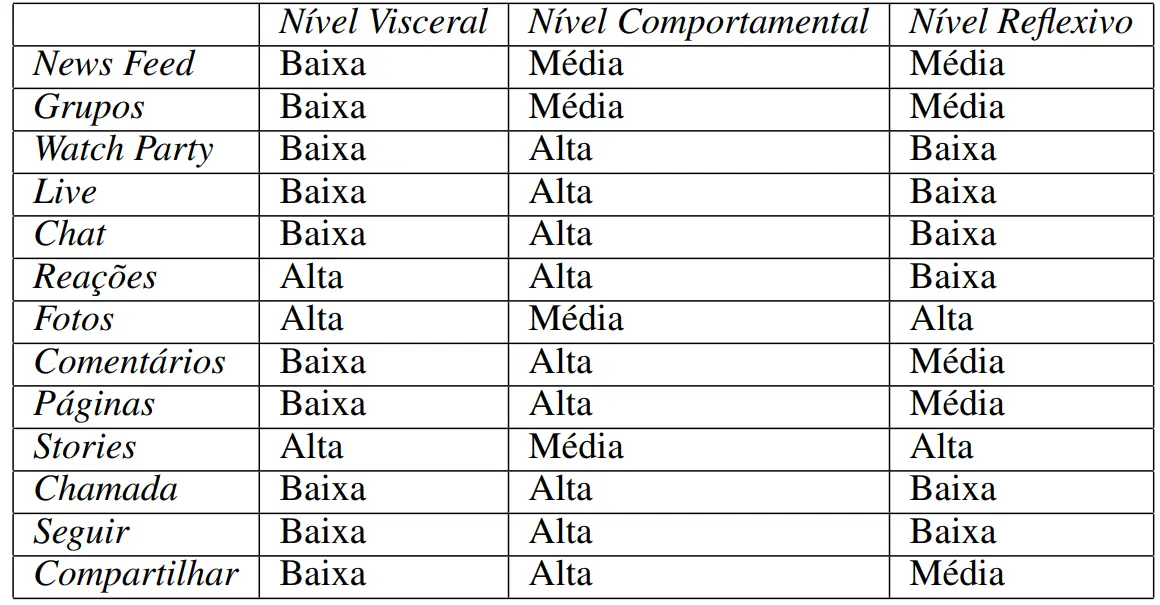
To quantify the presence of the levels of emotional design in social networks, I calculated the number of times each level occurred divided by the total number of evaluations, resulting in the frequency of each level.

From Table 3, the frequencies were weighted in order to determine which level appeared most. The result was obtained by applying the following expression to each level of emotional design:

The evaluation showed that the behavioral level was the most present. This makes sense, since social networks directly change the way people do the same activities they did before. Today, reading the news, looking at photos, watching movies, listening to music and many other activities have been changed in some way by social networks. It is not that social networks replaced these activities, but they offer a new way of doing them, which is interesting in many contexts, whether for interactivity, convenience, immediacy or any other reason. In second place comes the reflective level. Again, this makes sense, since social networks today occupy a very important place in people’s inner lives. Users care about the content they show others and also like to spend time looking at their virtual friends’ content. The need to show something interesting that brings prestige is constant among users. Last comes the visceral level. Indeed, people don’t go on social networks for the beauty of the interface, the shape of a button, the background color or the typography. People seek deeper relationships with the social network, which is why this level appears less, although it can occur at times.
Conclusion
This work proposed and carried out an evaluation of social networks through the lens of Don Norman’s emotional design. It makes it possible to understand more clearly why each social network feature exists and what happens in the user’s mind for the product to be adopted. It also showed that the most present level in social networks is the behavioral one. The great challenge of this work is trying to make a subjective subject objective, since many of the analyses here may divide opinions depending on the reader’s interpretation. A questionnaire to statistically understand why users use social networks could help make this research a little more objective. For example, finding out whether users use the photos feature more to share advertising or to engage with people’s stories, and from that concluding whether the reflective or the visceral level prevails. That is why it is important to understand that all levels of design can coexist, and the results shown here are an approximation based on the theory in Don Norman’s book. Anyone interested in the subject is strongly encouraged to build this theoretical foundation and read the book. Even with the limitations shown, this work is an original attempt to bring emotional design into this approach: first, by carrying out an evaluation, and second, by applying it to a context as specific as social networks. Reading these evaluations can give software designers insights and, consequently, lead to better products in terms of user experience.
References
John Terninko (1995). Step by Step QFD: Customer Driven Product Design.. CRC Press.
Ben Shneiderman (2004). Designing for Fun: How Can We Design User Interfaces to Be More Fun?interactions, 1(1), 48–50.
Pieter Desmet, Babette Porcelijn, & Matthijs van Dijk (2005). HOW to design WOW Introducing a layered-emotional approachProceedings of The International Conference on Designing Pleasurable Products and Interfaces, ‘’, 71–89.
Damien Lockner, & Nathalie Bonnardel (2015). Towards the Evaluation of Emotional InterfacesHuman-Computer Interaction, Part I, ‘’(‘’), 500–511.
Donald Norman, & Jakob Nielsen. (2016). The Definition of User Experience (UX).
Donald A. Norman (2002). The Design of Everyday Things. Basic Books, Inc..
Supavich (Fone) Pengnatea, & Rathindra Sarathyb (2017). An experimental investigation of the influence of website emotional design features on trust in unfamiliar online vendorsComputers in Human Behaviour, 1(1), 49–60.
Peter Hancock, Aaron A Pepe, & Lauren L Murphy (2005). Hedonomics: The power of positive and pleasurable ergonomics.Ergonomics in Design, 13, 8–14.
Donald A. Norman (2004). Emotional Design: Why We Love (or Hate) Everyday Things. Basic Books, Inc..
WoodGuy. (2011). Vintage Wireless Landline Dockss.
Leandro Miletto Tonetto, & Filipe Campelo Xavier da Costa (2011). Emotional Design: Concepts, approaches and research perspectives.Strategic Design Research, 1(1), 132–140.
Napier Lopez. (2016). Instagram Finally lets you zoom in on photos.
Pieter Desmet. (2011). Design for Happiness — TEDxHogeschoolUtrecht.
Daniel Kahneman (2003). A perspective on judgment and choice: Mapping bounded rationality.American Psychologist.
Donald A. Norman (2004). Emotional Design: People and Things.jnd.org, 1(1).
Statista. (2019). Most famous social network sites worldwide as of July 2019, ranked by number of active users.
Philippe Starck. (2009). Juicy Salif.
Jakob Nielsen (1994). Usability Engineering. Morgan Kaufmann.
Jonathan A. Obar, & Steve Wildman (2015). Social media definition and the governance challenge: An introduction to the special issueTelecommunications Policy, 39(9), 745–750.
Statista. (2020). The company behind the successful product.
Peter Adams (1993). Title of the ArticleThe name of the journal, 4(2), 201–213.